 AASTHA INTERNATIONAL
ATEX vs IECEx vs PESO: Key Differences, Certification Requirements & Where They Are Accepted
ATEX, IECEx and PESO are three important names in hazardous-area equipment, but they serve different purposes. ATEX addresses European regulatory requirements, IECEx provides an international Ex conformity-assessment system, while PESO regulates applicable hazardous-area equipment and installations in India. Understanding their differences is essential when purchasing ATEX mobile phones, intrinsically safe equipment and other Ex-certified industrial products.
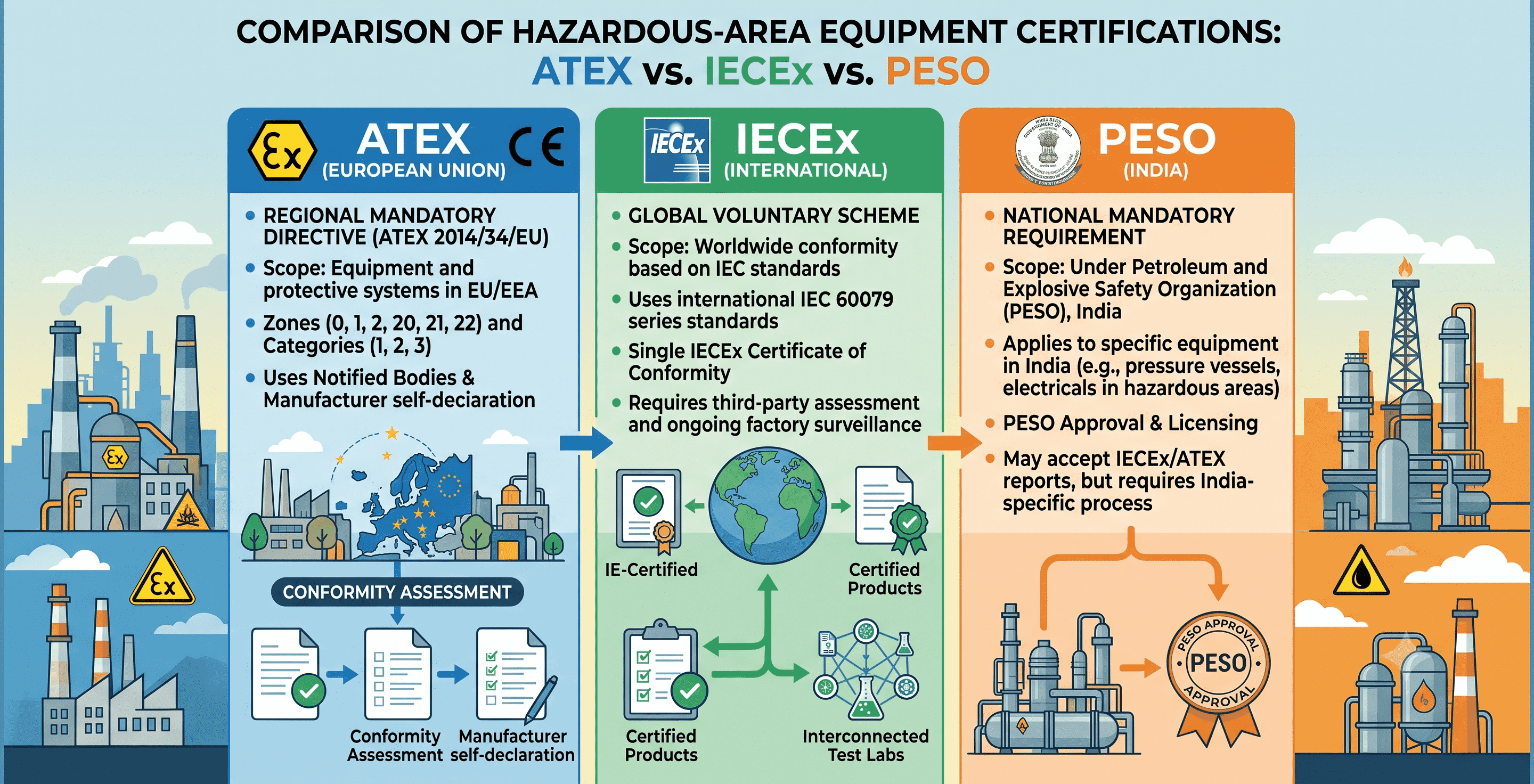
ATEX vs IECEx vs PESO: Understanding the Difference
When selecting equipment for hazardous areas, explosive atmospheres, oil & gas facilities, refineries, petrochemical plants and chemical industries, certification is one of the most important technical considerations.
Three names frequently appear in specifications and product documents:
- ATEX
- IECEx
- PESO
Although all three are associated with hazardous-area equipment and explosion-risk protection, they serve different regulatory and conformity-assessment purposes.
Understanding the difference is particularly important for companies purchasing ATEX mobile phones, intrinsically safe devices, flameproof equipment, hazardous-area electrical equipment, industrial communication devices and other Ex-certified products.
What Is ATEX?
ATEX is the European regulatory framework for equipment and protective systems intended for use in potentially explosive atmospheres.
The principal equipment directive is Directive 2014/34/EU. It establishes essential health and safety requirements and conformity-assessment procedures that apply before covered products are placed on the EU market. (Internal Market SMEs)
ATEX applies to equipment used in environments where explosive mixtures involving:
- Gases
- Vapours
- Mists
- Combustible dust
may occur.
Examples include equipment used in:
- Oil refineries
- Petrochemical plants
- Chemical plants
- Offshore installations
- Gas processing
- Fuel facilities
- Certain mining applications
- Dust-risk industrial environments
Where is ATEX applicable?
ATEX is primarily relevant to the European Union market for products within the scope of Directive 2014/34/EU.
Therefore, an ATEX certificate is particularly important when equipment is intended to be placed on the EU market and falls within the directive's scope.
However, an ATEX certificate does not automatically mean that the equipment satisfies every country's national approval requirement.
What Is IECEx?
IECEx stands for the IEC System for Certification to Standards Relating to Equipment for Use in Explosive Atmospheres.
Unlike ATEX, IECEx is an international conformity-assessment system rather than an EU product directive.
The IECEx Certified Equipment Scheme uses independent third-party assessment through approved Ex Certification Bodies (ExCBs) and Ex Testing Laboratories (ExTLs). Products that satisfy the applicable requirements can receive an IECEx Certificate of Conformity (CoC). (IECEx)
IECEx is based around international IEC standards for equipment used in explosive atmospheres.
According to IECEx, its Certified Equipment Scheme has recognition across more than 30 member countries, although national requirements and differences can still apply. (IECEx)
Where is IECEx accepted?
IECEx is designed to facilitate international acceptance of Ex equipment.
However, IECEx acceptance does not mean automatic legal approval in every country.
Some countries may:
- Accept IECEx directly
- Accept IECEx subject to national requirements
- Use IECEx certification as part of their national approval process
- Require additional national certification or registration
Therefore, the local regulatory requirements must always be checked before equipment is installed or placed into service.
What Is PESO?
PESO stands for the Petroleum and Explosives Safety Organisation.
PESO is India's statutory authority responsible for administering various safety requirements relating to petroleum, explosives, compressed gases and other hazardous substances under the applicable Indian laws and rules. (PESO)
PESO is therefore fundamentally different from ATEX and IECEx.
It is not simply another international Ex certification scheme.
PESO performs regulatory approval and safety functions within its Indian jurisdiction.
For certain electrical equipment used in hazardous areas falling under the Petroleum Rules, PESO states that approval of the Chief Controller of Explosives is required. PESO also states that foreign-manufactured electrical equipment intended for such hazardous areas requires approval before being put into use. (PESO)
ATEX vs IECEx vs PESO – Quick Comparison
|
Feature |
ATEX |
IECEx |
PESO |
|
Nature |
European regulatory framework |
International conformity-assessment system |
Indian statutory regulatory authority |
|
Main region |
European Union |
International |
India |
|
Primary purpose |
Requirements for covered products placed on EU market |
International Ex conformity assessment |
Indian hazardous-substance and hazardous-area regulatory approval |
|
Based on |
EU Directive 2014/34/EU |
IEC standards and IECEx rules |
Indian laws, rules and applicable standards |
|
Certification/approval |
ATEX conformity assessment and documentation |
IECEx Certificate of Conformity |
PESO approval where applicable |
|
Automatic worldwide acceptance |
No |
No |
No |
|
Relevant for India |
May support technical assessment but does not automatically replace Indian requirements |
Can support Indian approval process |
Directly relevant where PESO jurisdiction applies |
|
Relevant for EU |
Yes, for covered ATEX products |
May be technically useful but does not replace applicable EU requirements |
No |
|
International use |
Primarily EU regulatory market access |
Designed for international recognition |
Primarily India |
The Most Important Difference: Certification vs Regulatory Approval
A common misunderstanding is to consider ATEX, IECEx and PESO as three equivalent certificates.
They are not.
A useful way to understand them is:
ATEX
European regulatory conformity framework
IECEx
International Ex conformity-assessment system
PESO
Indian statutory regulatory approval framework
This distinction becomes particularly important when importing hazardous-area equipment into India.
Is IECEx Accepted in India?
IECEx certification is highly relevant to the Indian hazardous-area equipment market, but it should not be interpreted as a universal replacement for PESO approval.
PESO's current approval documentation specifically lists an IECEx Certificate of Conformity conforming to the applicable standards together with a valid IECEx Quality Assessment Report (QAR) among documents that can be submitted for approval. The same documentation also references EU Type Examination Certificates and other conformity documents in applicable cases. (PESO)
Therefore:
IECEx certification can support the Indian approval process, but the applicable PESO approval requirements still need to be satisfied.
For a specific product, the manufacturer/importer should verify the current PESO requirements applicable to that product and installation.
Is ATEX Accepted in India?
An ATEX certificate can provide important technical evidence because ATEX-certified products may have been assessed against relevant European/EN Ex standards.
PESO's published approval documentation recognizes EU Type Examination Certificates conforming to applicable standards as supporting documentation in specified approval processes. (PESO)
However, this should not be interpreted as:
"ATEX certification automatically equals PESO approval."
They are different regulatory processes.
For equipment intended for hazardous areas within PESO's jurisdiction in India, the applicable Indian approval should be confirmed before the equipment is installed or put into service.
Is PESO Certification Accepted in Europe?
PESO approval is an Indian regulatory approval.
It is not a substitute for the European ATEX conformity requirements applicable to covered equipment placed on the EU market.
If a manufacturer wants to sell covered equipment in Europe, it needs to address the applicable European regulatory requirements, including ATEX where applicable.
Similarly, an ATEX-certified product should not automatically be assumed to satisfy Indian PESO requirements.
Which Certification Is Required for India?
For an Indian hazardous-area project, the answer depends on the product, installation, applicable Indian regulations and intended use.
For electrical equipment falling within the relevant hazardous-area requirements of the Petroleum Rules, PESO states that approval is required. (PESO)
PESO's published guidance also identifies acceptable technical standards and supporting certification documents, including applicable BIS, IEC and EN standards and, in specified circumstances, IECEx and EU certification documentation. (PESO)
Therefore, a typical procurement process for India may look like:
IEC/EN Ex Certification → Technical Documentation → PESO Application/Assessment → PESO Approval → Installation/Use
The exact process depends on the equipment and applicable regulatory requirements.
What About ATEX and IECEx for Export Markets?
For manufacturers selling Ex equipment internationally, IECEx can be particularly useful because it is designed around international conformity assessment and recognition.
However, manufacturers should still check the destination country's regulations.
A product may therefore have multiple certifications or approvals.
For example, a hazardous-area mobile device could potentially be marketed with:
ATEX + IECEx + Indian PESO approval
This combination can help address different market and customer requirements, but each certificate/approval has its own scope and conditions.
ATEX, IECEx and PESO for Mobile Phones and Tablets
The difference becomes particularly important for hazardous-area smartphones, tablets and communication devices.
A normal commercial smartphone should not be assumed safe for use in an explosive atmosphere.
When purchasing an ATEX/IECEx mobile device for India, buyers should check:
- Exact device model
- ATEX certificate
- IECEx certificate
- PESO approval, where applicable
- Ex marking
- Gas group
- Temperature class
- EPL
- Zone suitability
- IP rating
- Battery configuration
- Charger/charging restrictions
- Camera configuration
- Accessories covered by certification
- Certificate validity/status
- Special conditions of use
Most importantly, the actual supplied device must correspond to the certified configuration.
Why the Exact Model and Configuration Matter
Certification belongs to a specific product configuration and certification scope.
For example, changing:
- Battery
- Charger
- Camera
- Antenna
- Enclosure
- Electronic components
- Display
- Communication module
may require certification consideration.
Therefore, a supplier should not simply provide an ATEX or IECEx certificate for a similar model and assume that it covers another configuration.
The model number, certificate number and Ex marking should be cross-checked.
Can One Certificate Replace Another?
Generally, no.
ATEX does not automatically replace IECEx.
ATEX is based on European legislation and conformity requirements, while IECEx operates as an international conformity-assessment system.
IECEx does not automatically replace ATEX.
If a product is subject to ATEX requirements for placement on the EU market, the applicable ATEX conformity requirements must be addressed.
ATEX/IECEx does not automatically replace PESO.
For equipment subject to Indian regulatory approval, applicable PESO requirements must be satisfied.
PESO does not replace ATEX.
PESO approval is an Indian regulatory approval and does not establish compliance with European ATEX requirements.
Where Are ATEX, IECEx and PESO Used?
ATEX
Primarily relevant to:
European Union market
Typical applications:
- Refineries
- Chemical plants
- Petrochemical facilities
- Oil & gas
- Manufacturing
- Dust-risk environments
IECEx
Designed for:
International markets participating in or recognizing IECEx
It is particularly useful for:
- Global oil & gas projects
- International EPC projects
- Multinational industrial companies
- Hazardous-area equipment manufacturers
- Export markets
IECEx itself notes that some established markets still require national or regional certification or approval, while other markets accept IECEx certificates where their regulatory framework allows it. (IECEx)
PESO
Relevant to:
India
Especially for equipment and installations falling within PESO's statutory jurisdiction, including relevant petroleum and hazardous-area applications.
PESO states that its regulatory responsibilities include hazardous electrical equipment such as flameproof, intrinsically safe and special electrical equipment used in hazardous areas. (PESO)
A Simple Example
Suppose a manufacturer produces an intrinsically safe mobile phone.
The product may have:
IECEx Certificate
→ Demonstrates conformity under the IECEx international scheme.
ATEX Certification
→ Addresses applicable European ATEX requirements.
PESO Approval
→ Addresses applicable Indian regulatory requirements for use in India.
These documents do not become interchangeable simply because they relate to the same product.
Each addresses a different regulatory or conformity-assessment framework.
Checklist Before Buying Ex-Certified Equipment
Before purchasing hazardous-area equipment, ask the supplier for:
Certification
- ATEX certificate, if required
- IECEx Certificate of Conformity, if required
- PESO approval, where applicable
Technical Information
- Complete Ex marking
- Zone suitability
- Gas/dust group
- Temperature class
- EPL
- IP rating
- Ambient temperature range
Product Verification
- Exact model number
- Hardware configuration
- Battery model
- Charger model
- Accessories covered by certification
Documentation
- Certificate
- Quality assessment documentation where applicable
- Technical datasheet
- User manual
- Special conditions of use
- Declaration/conformity documentation where applicable
Final Takeaway
ATEX, IECEx and PESO should not be treated as three interchangeable versions of the same certification.
ATEX is primarily a European regulatory framework for covered equipment and protective systems intended for potentially explosive atmospheres.
IECEx is an international conformity-assessment system designed to facilitate recognition of Ex equipment based on international IEC standards.
PESO is India's statutory safety regulator, and applicable PESO approval requirements must be considered for equipment used within its jurisdiction.
For international manufacturers and buyers, the most important question is therefore not simply:
"Does this product have ATEX or IECEx certification?"
Instead, ask:
"Which certification and regulatory approval does this specific product require for the country, hazardous area and intended application?"
That approach helps avoid certification gaps and ensures that hazardous-area equipment is selected according to the applicable regulatory and technical requirements.